Can the Police Stop Political Leaders from Attending a Rally? Understanding the Constitutional Limits on Police Powers

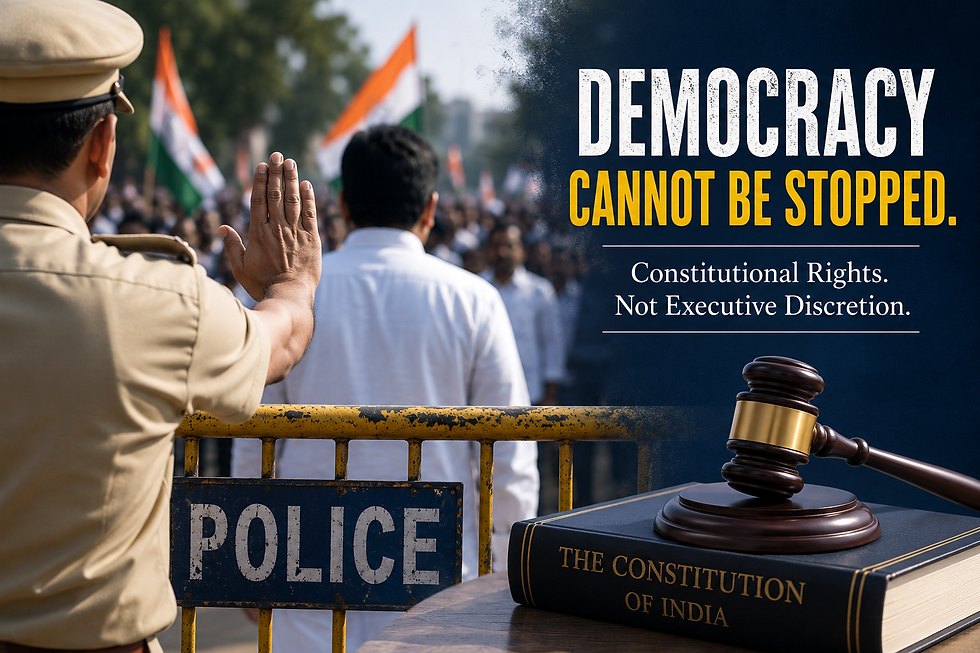
"The police are the guardians of law and order, not the guardians of political convenience."
Political rallies are the lifeblood of any democracy. They provide a platform for political parties to communicate with citizens, present their ideas, criticize the government, and mobilize public opinion. Whether organised by the ruling party or the opposition, political gatherings are an integral part of the democratic process protected by the Constitution of India.
However, questions often arise whenever major political events are scheduled. Can the police prevent opposition leaders from attending a rally? Can a political leader be stopped merely because the administration apprehends that his or her presence may create a law and order situation? Can preventive police powers be exercised solely on the basis of suspicion or political considerations?
These questions have gained renewed significance after reports of opposition leaders being restrained from attending political programmes. While maintaining public order is undoubtedly one of the primary responsibilities of the police, that responsibility must always be discharged within the framework of the Constitution. The police cannot become an instrument for restricting legitimate political participation under the guise of preventive action.
This article examines the constitutional position, the limits of police powers, and the safeguards available to every citizen.
Democracy Does Not End on Election Day
Democracy is much more than casting a vote once every five years. It is a continuing process that depends upon free political participation, public debate, criticism of the government, and the ability of political parties to communicate with the electorate.
The opposition is not an obstacle to democracy, it is one of its essential pillars. A healthy democracy requires the existence of a strong and effective opposition capable of questioning the government and presenting alternative viewpoints before the public.
If political leaders are prevented from addressing citizens or attending peaceful public programmes without lawful authority, the issue extends far beyond the rights of an individual leader. It directly affects the democratic process itself.
Which Constitutional Rights Are Involved?
The Constitution does not expressly confer a "right to attend a political rally." Instead, such participation is protected through several fundamental rights that operate together.
Article 19(1)(a): Freedom of Speech and Expression-
Political speech occupies one of the highest positions within constitutional protection. Addressing a public meeting, criticising government policies, or presenting a political viewpoint are all forms of protected speech.
Article 19(1)(b): Right to Assemble Peacefully
Citizens have the right to assemble peacefully without arms. Political meetings and public rallies fall within this constitutional protection, subject only to reasonable restrictions imposed by law.
Article 19(1)(c): Freedom to Form Associations
Political parties are associations protected under the Constitution. Their members possess the right to organise political activities in accordance with law.
Article 19(1)(d): Freedom of Movement
Every citizen has the constitutional right to move freely throughout the territory of India. Preventing a person from travelling to a lawful destination directly impacts this freedom.
Article 21: Protection of Personal Liberty
The Supreme Court has repeatedly held that personal liberty cannot be curtailed except by a procedure established by law that is just, fair and reasonable.
Article 14: Equality Before Law
The police cannot selectively exercise their powers based on political affiliation. Members of the ruling party and opposition parties stand on an equal footing before the Constitution.
Can the Police Restrict These Rights?
The answer is yes—but only within strict constitutional limits.
The Constitution itself permits reasonable restrictions in the interests of public order. However, these restrictions cannot be imposed arbitrarily or merely because the executive disagrees with the political views of a person.
For any restriction upon liberty to be constitutionally valid, certain basic conditions must exist:
There must be authority of law.
The action must pursue a legitimate public purpose.
The decision must be supported by objective material.
The statutory procedure must be followed.
The restriction must be proportionate to the purpose sought to be achieved.
A vague apprehension or a general claim that "law and order may be disturbed" cannot become a blanket justification for restricting political participation.
Preventive Police Powers Are Not Unlimited
The police possess preventive powers to maintain peace and public order. These powers are intended to prevent imminent breaches of peace and protect public safety.
However, preventive powers are exceptional powers. They are not meant to become instruments for controlling political activity or preventing lawful participation in democratic events.
The constitutional distinction is important. Preventing violence is a legitimate exercise of police power. Preventing political participation merely because it is inconvenient for the administration is not.
The Supreme Court Has Consistently Protected Personal Liberty
The Supreme Court has repeatedly emphasised that executive power cannot override constitutional freedoms.
In Maneka Gandhi v. Union of India, the Court fundamentally transformed the interpretation of Article 21 by holding that any procedure depriving a person of liberty must be fair, just and reasonable. Articles 14, 19 and 21 were recognised as forming the constitutional "golden triangle" protecting individual liberty.
In Joginder Kumar v. State of Uttar Pradesh, the Supreme Court made it clear that the mere existence of the power to arrest does not justify every arrest. The Court observed that the existence of power and the justification for exercising that power are two entirely different matters. Arrest must always be necessary and legally justified.
Similarly, in D.K. Basu v. State of West Bengal, the Court laid down mandatory safeguards governing arrest and detention and recognised that arbitrary police action strikes at the very foundation of the rule of law.
Bhim Singh: The Supreme Court's Strongest Warning Against Political Detention
Perhaps no judgment illustrates this issue better than Bhim Singh v. State of Jammu & Kashmir (1985).
Shri Bhim Singh, a Member of the Legislative Assembly, was arrested while travelling to attend a session of the Legislative Assembly. After examining the facts, the Supreme Court concluded that the only reasonable inference was that the authorities intended to prevent him from attending the Assembly.
The Court strongly condemned the conduct of the police and observed:
"Custodians of law and order should not become depredators of civil liberties. Their duty is to protect and not to abduct."
The Court further held that there had been a gross violation of Articles 21 and 22 of the Constitution and awarded monetary compensation for the illegal detention.
The importance of this judgment extends far beyond its facts. It establishes the constitutional principle that police powers cannot be used to suppress legitimate political participation.
Can the Police Act Only on Oral Instructions?
One troubling feature frequently reported in such situations is the claim that police officers are acting on "orders from above."
In a constitutional democracy, restrictions upon personal liberty cannot ordinarily rest upon undisclosed oral directions. Whenever liberty is curtailed, there must be a legal basis for the action.
A citizen is entitled to know:
Under which law is the restriction imposed?
Which authority passed the order?
What are the recorded reasons?
What material justified such action?
Executive convenience cannot replace constitutional procedure.
What Can a Citizen Do?
If a political leader or any citizen has been unlawfully restrained by the police and is subsequently released, the matter should not be treated as closed merely because the restraint has ended. An illegal restriction on personal liberty is not cured simply by the person's release. The Constitution provides remedies not only to challenge the past action but also to prevent its recurrence.
The affected person may consider the following legal steps:
Document the incident immediately by preserving photographs, videos, CCTV footage, mobile recordings, media reports, and statements of eyewitnesses. Such evidence is often crucial in establishing the circumstances of the restraint.
Seek disclosure of the legal basis for the action by requesting copies of any written order, detention memo, preventive action order, General Diary entries, or other official records that formed the basis of the restraint.
Submit a formal representation to the Superintendent of Police, District Magistrate, and other competent authorities, recording the incident and requesting that no similar action be taken in future except strictly in accordance with law.
Seek relevant official records through appropriate legal mechanisms, including applications under the Right to Information Act wherever permissible, to ascertain whether any lawful authority or statutory procedure was invoked.
Approach the High Court under Article 226 of the Constitution seeking appropriate reliefs, including:
a declaration that the earlier restraint was illegal and unconstitutional;
directions restraining the authorities from repeating such arbitrary action in future;
production of the records on the basis of which the action was taken; and
any other consequential relief considered appropriate by the Court.
Seek constitutional compensation, where the facts disclose unlawful detention or a violation of fundamental rights, in accordance with the principles recognised by the Supreme Court.
What If It Happens Again?
If, despite these steps, the authorities once again restrain a person without lawful authority, immediate constitutional remedies remain available. Depending upon the nature of the restraint, the affected person may:
Move the High Court under Article 226 for urgent intervention.
File a writ of Habeas Corpus if the person is illegally detained or confined.
Challenge the action as arbitrary, mala fide, and violative of Articles 14, 19, 21, and, where applicable, Article 22 of the Constitution.
Seek production of the written order, statutory authority, and material relied upon by the police.
Claim appropriate compensation and seek departmental action if the restraint is ultimately found to be unlawful.
The Supreme Court has consistently emphasised that preventive police powers are not unfettered. They must be exercised strictly within the limits prescribed by law, and every restriction on personal liberty remains subject to judicial review. In a constitutional democracy, the release of an individual does not erase an earlier violation of fundamental rights, nor does it prevent the constitutional courts from granting appropriate relief to ensure that such violations are not repeated.
The Kanoon Angle
Maintaining public order is a legitimate responsibility of the State, but it cannot come at the cost of personal liberty or democratic participation. Preventive police powers are exceptional and must be exercised strictly in accordance with law, supported by objective reasons, and subject to judicial review.
Stay informed. Stay empowered. Follow The Kanoon Angle for your daily dose of law made simple.


Comments